De Hofberg, Rotterdam

In collaboration with JEP Vastgoed and Vink Bouw, Orange Architects designed an urban infill piece between the Insulindestraat and the Hofbogenpark. De Hofberg comprises a residential building with 28 urban townhouses that completes the Spoordriehoek, while an integrated public route creates a connection between the neighborhood and the park.

Conceptually, De Hofberg can be read as an intimate, landscaped sloping alley, flanked on both sides by buildings, that naturally bridges the level difference between Insulindestraat and Hofbogenpark. Shaping this artificial hill, leads to a clear programmatic separation between parking and living. Car-parking is accommodated within the hill, while the homes are situated on top of it.

Because both sides of the courtyard are programmed and provided with a designed façade, an attractive ‘sociopetal’ in-between space emerges, highly suitable for meeting and interaction.

Instead of designing a perimeter block with an independent stairway to the Hofbogenpark next to it, De Hofberg places the route at the heart of the plan. In this way, the residential program and the connection reinforce each other, creating an embracing urban space that not only ties the city to the park, but also connects new residents to the existing neighborhood.
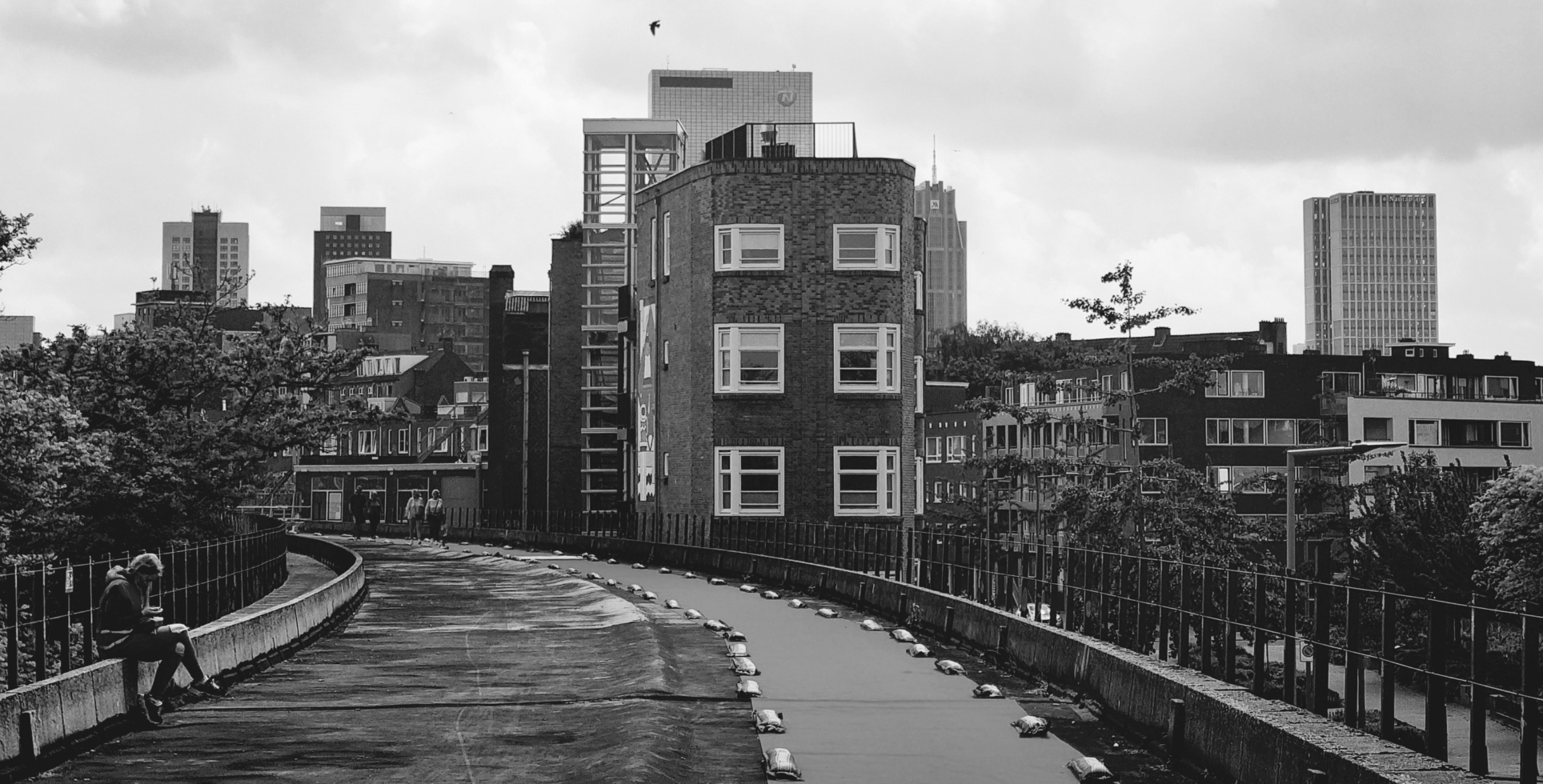


On the street side, the building volume is carefully embedded within the urban framework of the Spoordriehoek. Here, the building has a classical vertical composition, articulated in a contemporary way. On the park side, De Hofberg presents a softer and more informal expression. The central in-between street creates two slender volumes facing Hofbogenpark. Through the strategic positioning of the access-cores, the two volumes are shifted in relation to one another, allowing them to elegantly follow the curve of the former Hofpleinlijn. By stepping back both volumes, the relationship with the park becomes gentler, while the visual axis from the park towards the city is strengthened.

By not placing the residential program on one side of the plot, but instead splitting it and sliding it up against both adjacent boundaries, more façade length and daylight is created for the homes. The residential program, starting from the second ground level, is characterized by a clear east–west orientation. By allowing daylight to enter primarily through the end façades of the homes, the side façades facing the courtyard can be more closed, while still being designed with ‘eyes’ on the passage.
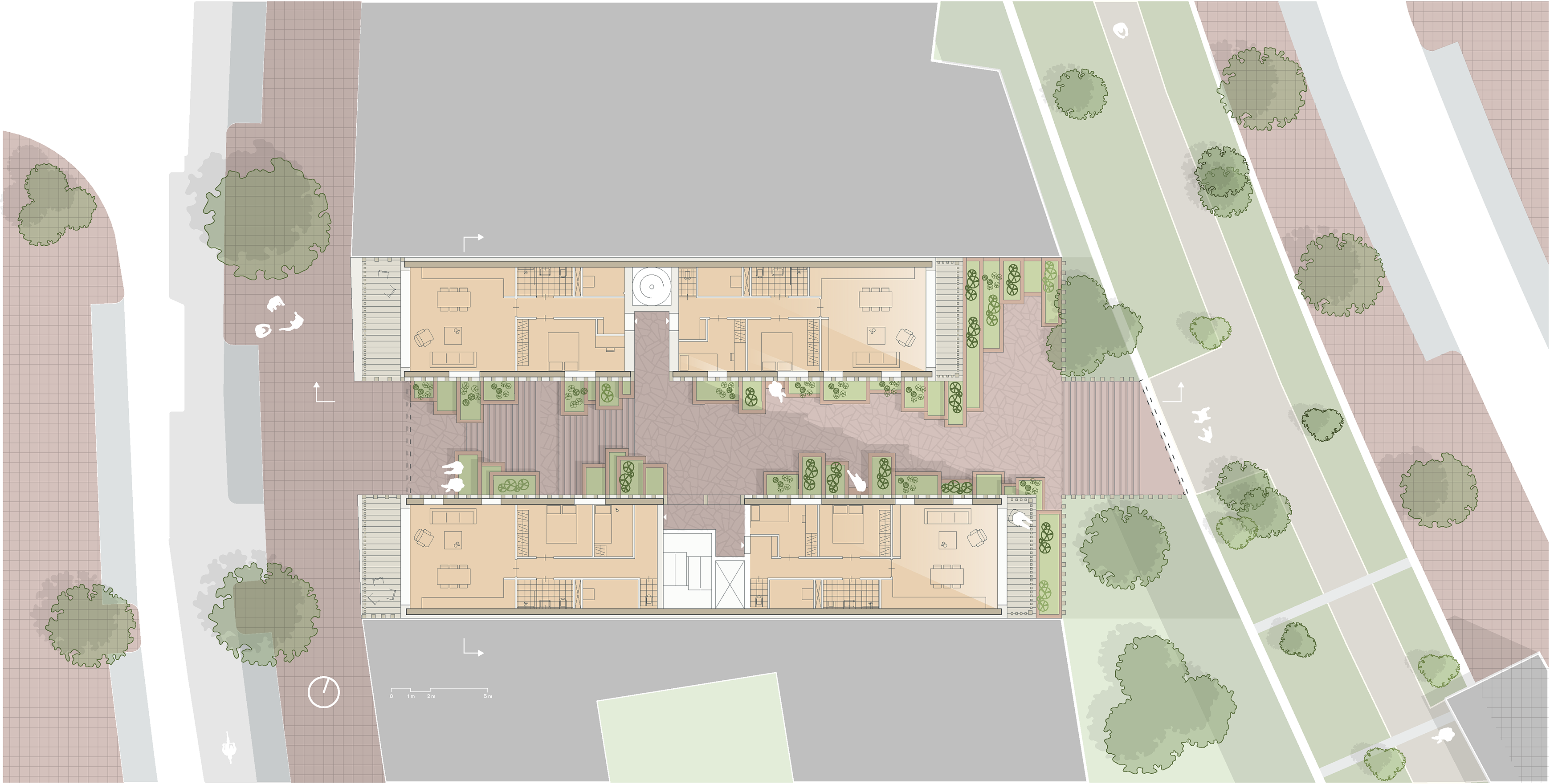

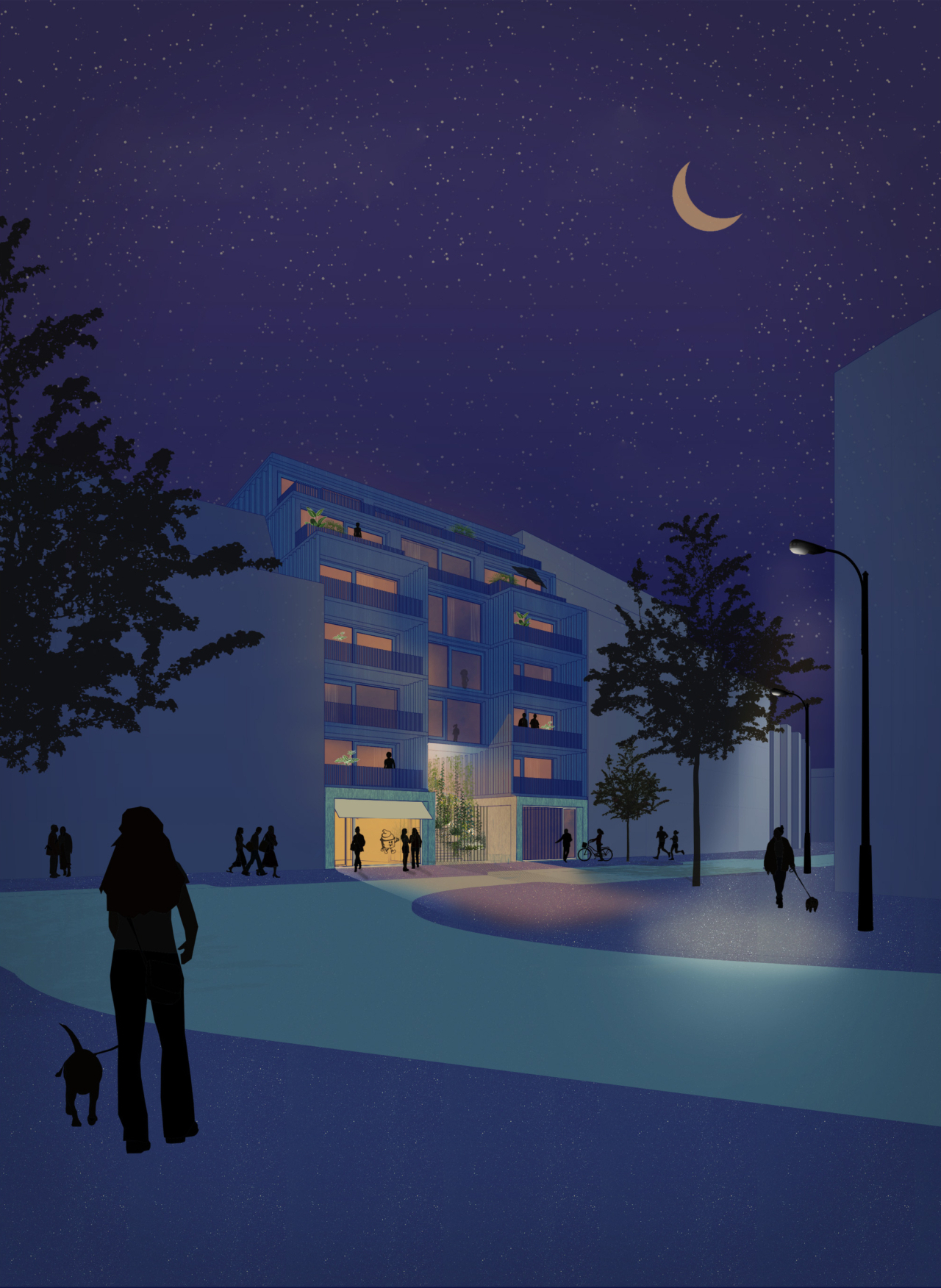
Thanks to the compact layout of the parking garage, space can be kept free along the angled park edge. Here, a collective bicycle storage facility—beneath the staircase leading up to Hofbogenpark—and two green patios in open ground level are proposed. Initially, the patios bring daylight into the basement and provide views of greenery from the homes and from the park. In a future scenario, these spaces could also be used as outdoor areas for the commercial functions beneath the Hofbogen. For this, a future relation can be organized with the already present business owners.
The residential program, starting from the second ground level, is characterized by a clear east–west orientation. The structural principle of the homes supports a flexible, future-proof floorplan layout. The configuration of the dwellings—together with the position of the access cores—ensures that all homes have a two-sided orientation. The dwellings look out towards both the street or park side, and the in-between space.

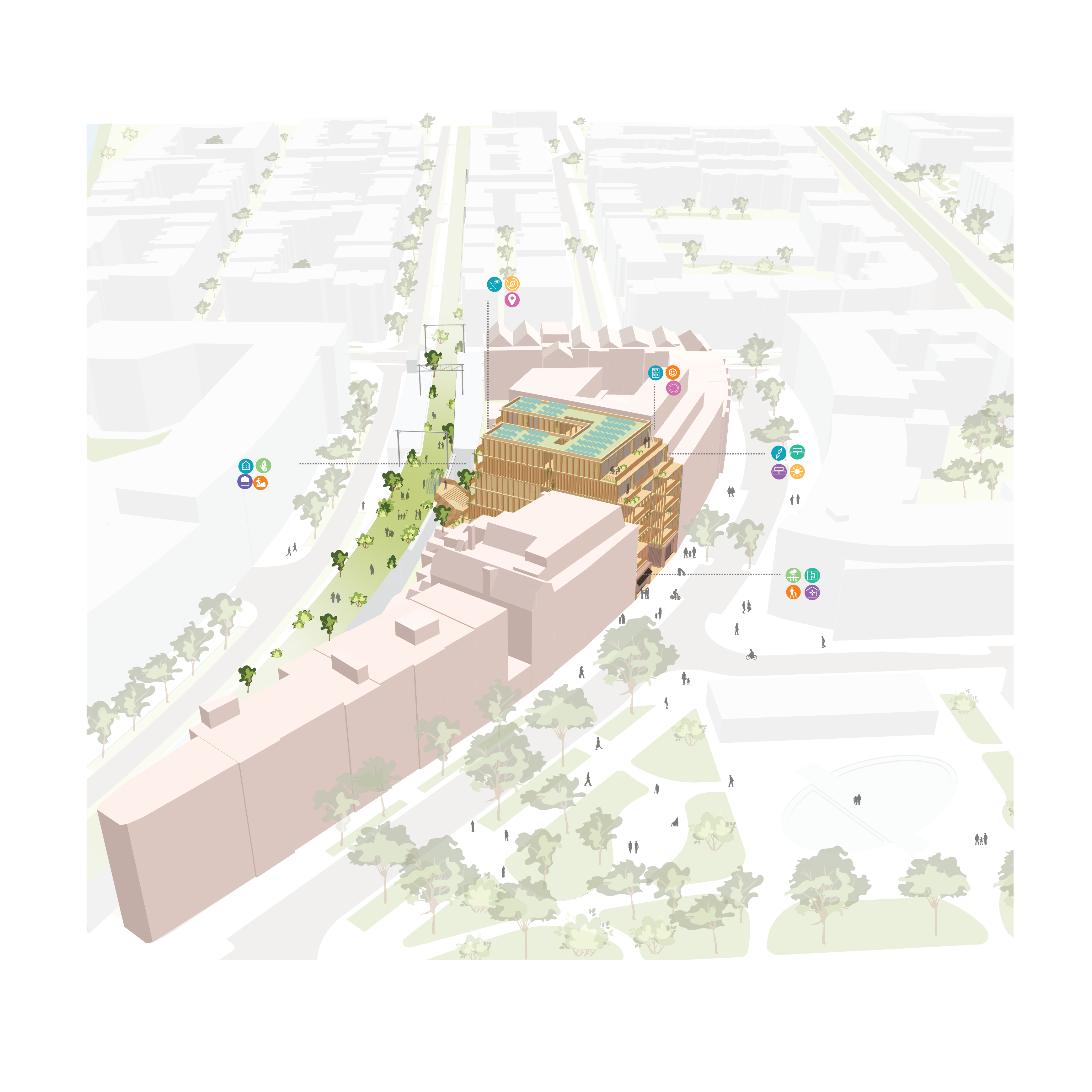

By creating a physical connection to Hofbogenpark, the neighborhood can be linked to the city’s green-blue network and benefit from its climate-adaptive measures. In addition to climate adaptation and nature inclusivity, the project focuses on the use of circular, bio-based materials. For the top structure, we propose a sustainable construction system, such as prefabricated timber CLT walls and floors, and timber-finished external façades.
On the rear side of the building, intensive greening allows De Hofberg to root itself at the edge of the park.

Project Details
- Site
- Rotterdam
- Client
- Vink Bouw, JEP Vastgoed
- Design
- 2024
- Size
- 2.864 m2
- Program
- Housing
- Assignment
- Tender
- Team
- Patrick Meijers, Jeroen Schipper, Rik Meijer, Elena Staskute, Georgiana Condurachi, Irina Vaganova
- Visuals
- Orange Architects